
Custom software development services cover the full lifecycle of designing, building, testing, and maintaining software built specifically for one organization's workflows. The right time to commission custom development is when two or more of these conditions are true: your team has built workarounds inside a SaaS tool within 90 days, your integration middleware costs more than the SaaS subscription it connects, the workflow controls a core competitive differentiator, or per-seat SaaS pricing is compounding faster than headcount. For a 200-seat team, custom development breaks even against true SaaS total cost of ownership at 14 months. The lowest-risk entry point is an 8-to-12-week Build Sprint: a scoped, time-boxed engagement that delivers production-ready software and client-owned code before a full platform build is committed.
-
$21M annual wasteAverage enterprise SaaS shelfware cost; only 49% of licenses are actively used
-
2.5x–4x true TCOEnterprise SaaS real cost once integration, training, and support are counted
-
14-month breakevenWhen a 200-seat custom build crosses SaaS total cost of ownership
-
60–70% more accurate estimatesWhat a structured discovery phase delivers versus pre-discovery rough quotes
-
52.7% of projects exceed budgetPrimary risk a rigorous discovery process and QA investment directly cuts
-
8–12 weeks to productionBuild Sprint timeline from discovery to working, client-owned custom software
-
16x higher switching costsWhat vendor lock-in costs organizations without prevention planning in place
-
$65.85B market in 2026Global custom software development market size, growing at a 22.1% CAGR
As of September 2026, the global custom software development market has reached $65.85 billion. Growing at a 22.1% CAGR from $53.95 billion in 2025. That growth is not driven by startups or Fortune 500 megaprojects. It is driven by mid-market operations leaders, COOs, VPs of Operations, CTOs at 50-to-2,000-seat companies, who ran the numbers on their SaaS stack and found that another subscription renewal was more expensive than building the tool themselves. This guide is the framework they used to make that decision, the cost structure that made the math honest, and the Build Sprint entry point that let them prove value in 8–12 weeks before committing to a full platform build.
Custom software development services cover the full lifecycle of designing, building, testing, and maintaining software built specifically for one organization's workflows. As opposed to off-the-shelf software shared across thousands of customers. This guide covers the four-lens decision framework (workflow fit, integration cost, ownership, and workaround burden), real cost ranges for custom development ($25,000–$250,000+), named tools and platforms, and the structured Build Sprint entry point that lets mid-market teams prove value in 8–12 weeks before committing to a full platform build. It does not cover enterprise megaprojects above $1M, consumer app development, or gaming. The right reader is a 50-to-2,000-seat organization that has already tried two or three SaaS tools for a problem and still has a measurable operational gap.
When Buying Another SaaS Tool Makes the Problem Worse
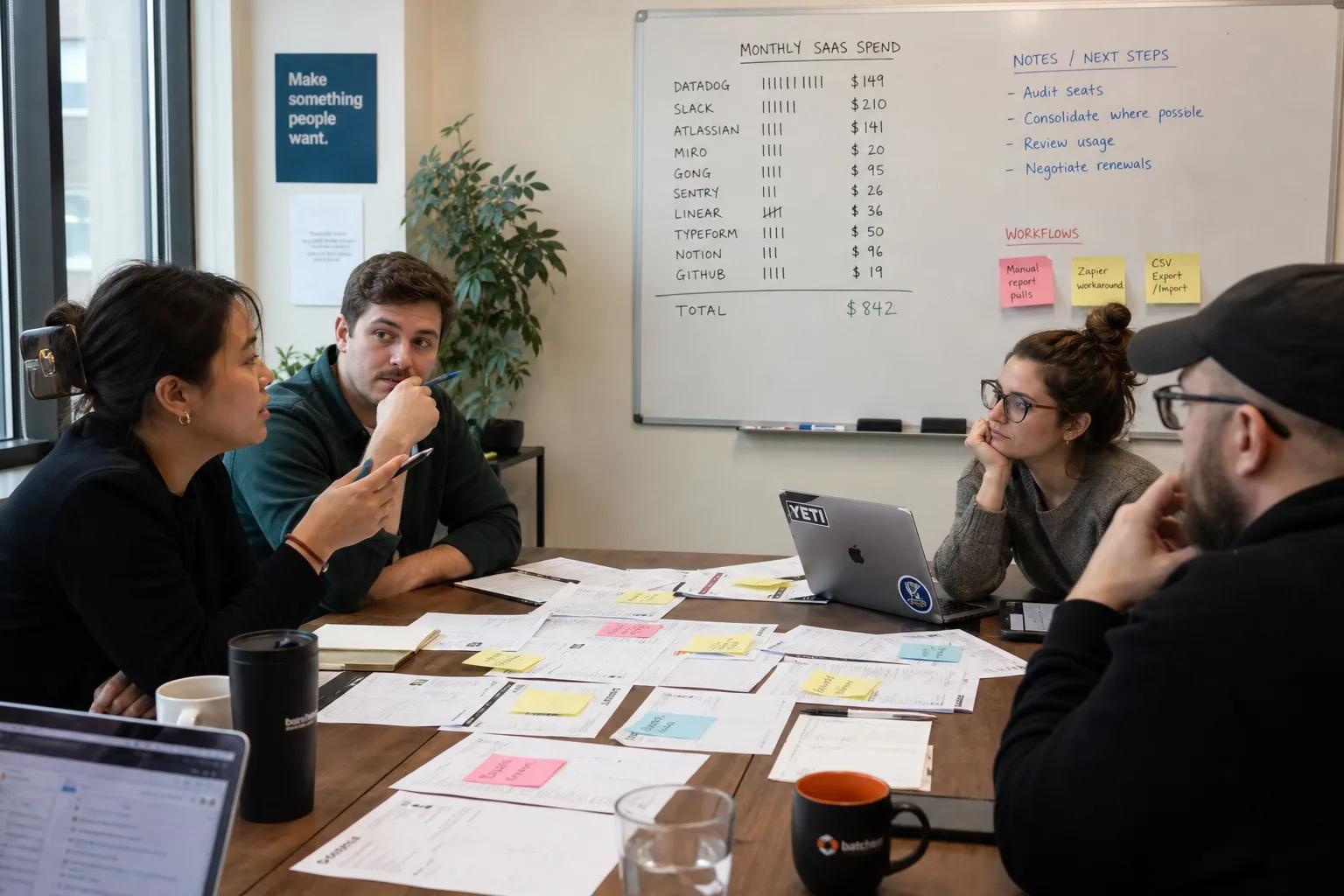
The SaaS sprawl problem is quantifiable: knowledge workers who toggle between disconnected applications lose 20–30% of productive time, and the average mid-market firm running 1,000–5,000 employees now operates 100–150 SaaS apps simultaneously. That app count represents an average spend of $10,800 per employee per year as of 2026, up from $9,643 in 2025. When 80% of SaaS features go unused, a figure Pendo research puts at $29.5 billion in wasted cloud R&D industry-wide, the math stops favoring the subscription model.
The true total cost of ownership for enterprise SaaS is 2.5x–4x the advertised sticker price once integration, training, implementation, and ongoing support are counted. AI-feature surcharges alone have driven enterprise SaaS expenses up an average of 34% since 2024, and major vendors raised prices 8–22% between 2024 and 2025: Salesforce pushed enterprise contracts up 19% in 2025, with Adobe, Microsoft, Oracle, IBM, and ServiceNow following. A budget line that reads $120,000 per year on the contract often costs $300,000–$480,000 when the full stack is audited. These are not rounding errors. They are structural costs that every SaaS renewal buries in separate line items.
Four Signals That Tell You Off-the-Shelf Software Has Failed
- The team has built a parallel spreadsheet or manual process to compensate for what the tool cannot do. These are workaround hours, and they cost real money.
- The company pays for two or more tools that partially overlap because neither does the job alone, creating complex integrations and redundant spend.
- A new integration middleware layer, Zapier, Workato, or MuleSoft, now costs more annually than the original SaaS subscription it connects.
- The workflow in question is core to how the company wins business, meaning a vendor's product roadmap now controls a competitive differentiator.
Any two of these signals justify running the build-vs-buy numbers. The workaround cost is the most underestimated line item. Removing just 30 minutes of daily manual work per employee at 500 staff represents $650,000 in annual recovered productivity at a $50/hour average cost. Before any licensing savings are counted. A 67% majority of mid-market technology leaders reported at least one critical operational constraint caused by SaaS limitations in the prior 18 months as of a 2025 survey, up from 41% in 2023. That is not a vendor problem. That is a structural mismatch between generic software solutions and specific business processes.
Digital transformation initiatives built on SaaS stacks alone tend to stall at exactly the point where the process becomes proprietary. Off-the-shelf software adapts organizations to the vendor's model of how work should flow. Custom software adapts to how work actually flows. And that distinction determines whether digital transformation delivers measurable business outcomes or just adds subscription cost. As of 2026, 55% of enterprise apps are shadow IT apps, meaning employees are already finding workarounds outside sanctioned systems. That is not a compliance problem first. It is an operational fit signal.
The true TCO of enterprise SaaS runs 2.5x–4x the sticker price, and 61% of organizations cut projects in 2026 because of unplanned SaaS cost increases. Making the status quo more expensive than any contract summary shows.
The 4-Lens Framework: Custom Software Solutions vs. SaaS
Lens 1: Workflow Fit: Does the Software Adapt to Your Process or Vice Versa?
Off-the-shelf tools are built for the median customer. If your operational process differs from that median in a way that affects revenue, quality, or compliance, the tool creates friction at exactly the wrong point. The clearest signal: if your team built a documented workaround within the first 90 days of a SaaS deployment, the tool does not fit. Commodity business processes, accounting, payroll, standard HR, almost always buy. Proprietary fulfillment, quoting, scheduling, or customer-data workflows that encode how the company wins business almost always build. Tailored software solutions for those workflows deliver competitive advantage that a shared SaaS product structurally cannot.
Lens 2: Integration Complexity: What Does the Middleware Stack Actually Cost?
Every additional SaaS tool that cannot natively connect to core systems requires software integration services in the form of integration middleware. MuleSoft starts at $80,000–$100,000 per year for enterprise tier; Workato runs $15,000–$50,000 per year for mid-market deployments; Zapier covers simple automations from $19.99 per month but breaks under transaction volume. When the annual cost of integration middleware approaches or exceeds the cost of the SaaS subscription it connects, that spend alone often funds a custom build. Count every middleware license, every API call overage, and every developer hour spent maintaining connectors before comparing sticker prices. System integration cost is the most systematically hidden number in a SaaS stack audit.
Lens 3: Ownership and Vendor Dependency: Who Controls Your Core Workflow IP?
If a process touches the company's core competitive differentiator, it should be built. Relying on a third party for your core value proposition creates a strategic vulnerability that compounds over time. Organizations trapped in vendor lock-in situations face switching costs that are 16 times higher than those with proper prevention planning, and the average cost to switch enterprise software vendors is $2.1 million. Beyond switching cost, annual price escalation clauses of 5–10% are standard in enterprise SaaS contracts, meaning a $200,000 annual contract becomes $293,000–$322,000 within five years at those rates. Complex enterprise systems built on legacy systems with proprietary data formats compound this risk further. Modernize before the lock-in deepens.
Lens 4: Workaround Burden: Count the Hours, Then Do the Math
Count the weekly hours your team spends working around a tool's limitations and multiply by fully-loaded hourly cost. The 20–30% productivity reduction for knowledge workers toggling between multiple platforms is not theoretical. It shows up in output per employee when measured against pre-SaaS baselines. A score of 10+ workaround hours per week per 10 employees at $75/hour loaded cost equals $390,000 in annual friction. That number belongs in the ROI model, not in a footnote. Data analytics on workaround frequency, by user role, should be the first deliverable of any honest build-vs-buy analysis. Complex business operations with high workaround burden are the clearest signal that tailored solutions will deliver measurable business outcomes faster than another SaaS renewal.
Running all four lenses before signing a SaaS renewal or commissioning a custom build cuts the probability of a compounding cost error by identifying which path wins on a 3-to-5-year TCO basis. And a poor decision compounds those losses 2–5x over that period.
Custom Software Development Cost: Real Ranges and the Breakeven Math
US senior developer hourly rates in 2026 run $150–$220 per hour for engineers with AI and compliance technical expertise; mid-level engineers bill at $100–$150 per hour. AI-assisted development tools, Cursor and GitHub Copilot are the two dominant options as of September 2026, have reduced code-writing time by an estimated 30–50% on well-defined tasks, which compresses timelines and lowers total build cost without reducing quality when used by senior engineers. Software development outsourcing to nearshore teams in Mexico and Colombia runs $60–$90 per hour for equivalent seniority, though time-zone overlap and IP contract structure add management cost that narrows the savings gap. The honest custom software development cost for a mid-market application from a US-based firm lands between $60,000 and $180,000 for a production-ready, integrated system.
Scope creep is the budget killer that 52.7% of software projects experience when they exceed initial budgets. Unplanned feature additions extend timelines 15–30% and inflate budgets accordingly; building against wrong assumptions costs $15,000–$30,000 in rework on a typical custom web application. Regulatory compliance requirements add 2–6 weeks of audit preparation for HIPAA, GDPR, SOC 2, or PCI-DSS projects. These are not surprises. They are predictable costs that a custom software development company must price into the proposal. A vendor who does not discuss compliance timeline in the first conversation is a vendor who will bill for it in change orders by month four.
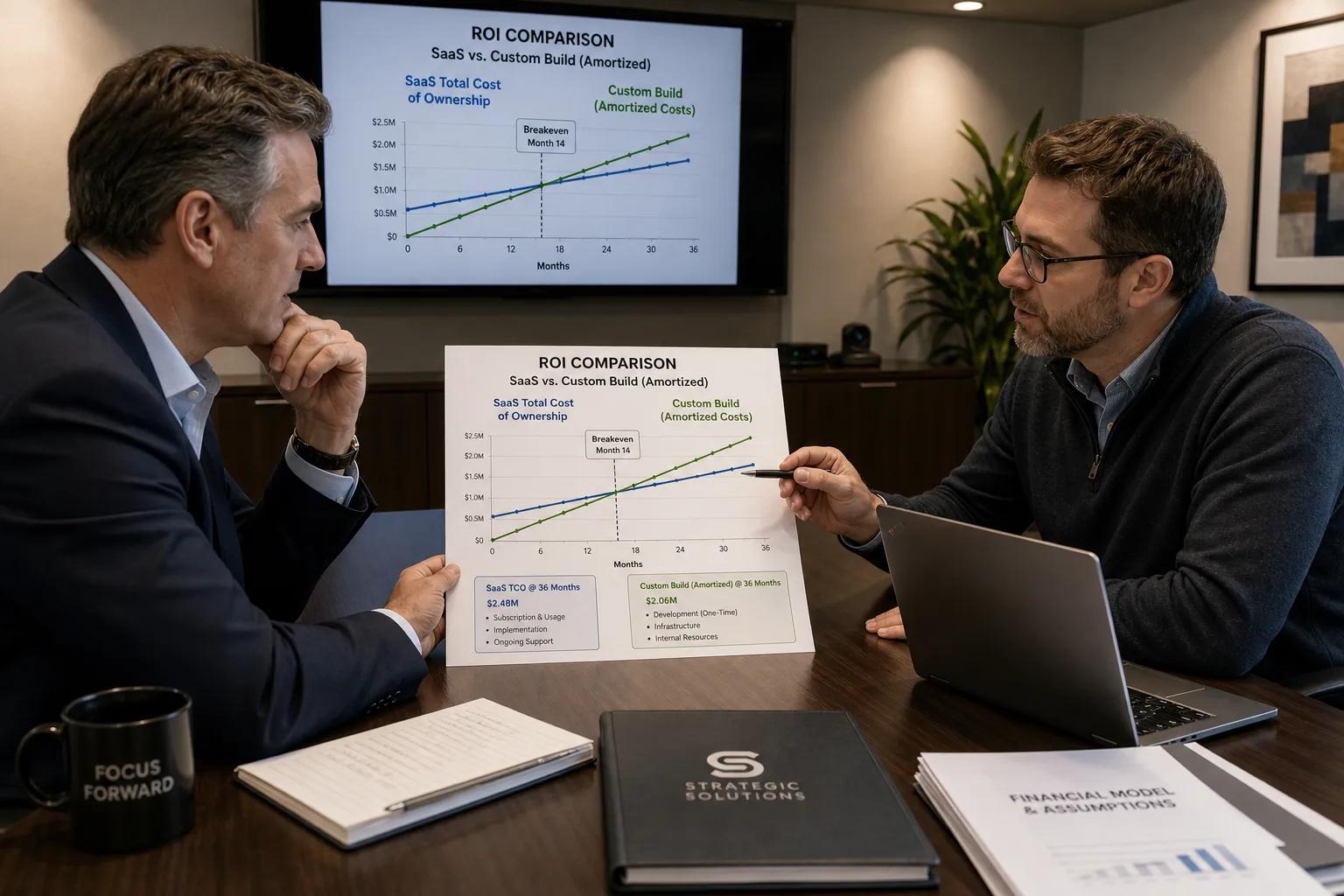
The breakeven model works as follows: take the honest SaaS TCO, sticker price multiplied by 2.5–4x for integration, training, implementation, and support, subtract it from the custom build cost amortized over three years, then add back the recovered workaround productivity. For a 200-seat team spending $180,000 per year on a SaaS stack with $270,000–$480,000 in true annual cost, a $150,000 custom build amortizes to $50,000 per year over three years. The gap is $220,000–$430,000 per year. And that number grows every year the SaaS vendor escalates prices. The 14-month breakeven is conservative; it does not include license consolidation savings or the value of owning the software development lifecycle and roadmap outright.
One cost that rarely appears in vendor proposals: post-launch support. Budget 15–20% of the initial build cost annually for ongoing maintenance, bug fixes, security patches, and incremental feature updates. A $100,000 custom application costs $15,000–$20,000 per year to maintain. Compare that to a SaaS subscription that raises rates 8–22% annually with no corresponding improvement in workflow fit. Agile software development with quarterly release cycles keeps that maintenance cost predictable and prevents the codebase from accumulating technical debt that inflates future change costs. Cloud solutions deployed on AWS, Google Cloud Platform, or Azure benefit from managed infrastructure that reduces the operational overhead of that ongoing maintenance.
A 200-seat team breaks even on a custom build versus SaaS TCO at 14 months; even a 50-seat team hits breakeven at 28 months. And that calculation does not include compounding savings from owning the roadmap and eliminating annual SaaS price escalation.

The Discovery-First Build Sprint: From Workflow Gap to Working Custom Software
Discovery Phase: The Step Most Buyers Want to Skip
Discovery is the phase most buyers want to skip and most experienced custom software development companies refuse to skip. For any custom software project over $50,000, spanning more than three months, or touching multiple user roles or external API integrations, a formal discovery phase of 1–4 weeks is non-negotiable. Discovery outputs include: a verified requirements document, data flow diagrams, wireframes for every user role, API contracts for every integration point, and a risk-adjusted timeline with scope boundaries. The $15,000–$30,000 cost of discovery on a $100,000 project scope is the cheapest insurance available against the 15–30% scope creep that derails projects built against assumptions. Skipping it is not frugality. It is transferring budget from a known cost to an unknown change order.
Tech Stack Selection: A Business Decision, Not a Developer Detail
The Build Sprint tech stack decision happens during discovery, not after. For most mid-market custom applications in 2026, the production stack includes a React or Angular front end, a Node.js or Python back end, PostgreSQL or a cloud-managed database on AWS or Google Cloud Platform, and a CI/CD pipeline with automated testing built in from day one. Mobile app development that requires cross-platform iOS and Android reach typically uses React Native to reduce development cost by 30–40% versus separate native builds. The tech stack choice affects every future maintenance, scalability, and integration decision. It is not a detail to defer to the development team without leadership input on cloud migration strategy and long-term portability.
The Three-Phase Build Sprint Structure
- Weeks 1–2: Discovery, requirements finalization, wireframes, API contracts, and sprint planning. Every user role is documented; every integration point has a contract before a line of code is written.
- Weeks 3–8: Agile software development in two-week sprints with working software demonstrated at each sprint review. No dark-room development. The dedicated team meets, shows real output, and adjusts.
- Weeks 9–12: Quality assurance, user acceptance testing, integration testing against all external systems, security review, and production deployment. QA is not an afterthought. It is a named phase with a defined exit criteria.
The dedicated team on a Build Sprint typically consists of a product owner (client-side), a lead engineer, one or two mid-level developers, a QA engineer, and a UI/UX designer. That team structure is leaner than a full product team and keeps weekly burn rate predictable. The Build Sprint produces three outputs beyond the software itself: a documented codebase the client owns outright, a roadmap for Phase 2 features with effort estimates grounded in real sprint velocity, and a post-launch support plan covering the first 90 days. Flexible engagement models after the Build Sprint include a retainer for ongoing maintenance ($5,000–$15,000 per month depending on complexity), a time-and-materials model for Phase 2 feature development, or a fixed-price contract for a defined next module.
A structured discovery phase makes Build Sprint estimates 60–70% more accurate and cuts development time 35–50% by eliminating assumption-driven rework. Making the 8-to-12-week Build Sprint the lowest-risk way to validate custom software ROI before committing to a full platform build.
Choosing the Right Custom Software Development Company: 6 Criteria That Matter
Criterion 1: Industry Expertise and Reference Accounts
A custom software development company should name three clients in your industry or a closely adjacent vertical and describe the specific operational problem solved. Not just the technology used. Ask for a case study that includes the pre-build workflow, the integration points, the timeline versus estimate, and the post-launch support outcome. Generic portfolios with polished screenshots but no operational context signal that the firm sells software development hours, not business outcomes. Industry expertise is not a nice-to-have. It cuts requirements gathering time, surfaces compliance requirements early, and produces custom solutions that actually fit the regulatory environment your team operates in.
Criterion 2: Discovery Process Rigor
The best custom software developers will not give a fixed price without a discovery phase for any custom software project above $50,000. A firm that quotes a $150,000 project in a 30-minute call without reviewing your data model, your integration list, and your user roles is pricing from assumptions. And you will pay for those assumptions in change orders. Ask specifically: what does your discovery phase produce, how long does it take, and is it separately priced? A separately priced discovery ($10,000–$25,000 for most mid-market projects) is a quality signal, not a upsell. It means the firm understands that the custom software development process starts with verified requirements, not with optimistic guesses.
Criterion 3: Tech Stack Transparency and Client Ownership of IP
The software development lifecycle should produce code that lives in a client-controlled repository from day one. Confirm that all source code, documentation, and deployment configurations transfer to client ownership at project completion. Ask which cloud platform the application will be deployed on, AWS, Google Cloud Platform, or Azure, and whether the architecture supports cloud migration to an alternative provider without a full rewrite. Lock-in to a proprietary hosting environment is a structural risk equivalent to the SaaS vendor lock-in the custom build was commissioned to solve. Scalable solutions are portable solutions.
Criteria 4–6: Quality Assurance, Engagement Models, and Communication
Quality assurance must be a named line item in the proposal, not an afterthought in week 11. Automated testing coverage of 70–80% of core business logic is the standard for production-grade custom applications. Ask the firm what their QA-to-developer ratio is on a typical engagement; ratios below 1:4 on a compliance-sensitive project are a risk flag. On flexible engagement models: a quality custom software development company offers at least three options. Fixed-price for well-defined projects, time-and-materials for evolving business goals, and staff augmentation for clients with an in-house development team that needs specific technical expertise. On communication: weekly sprint reviews with working software demonstrations, a shared project management environment (Jira or equivalent), and a named development partner contact who is not the salesperson are the baseline standards. Firms that handle scope changes verbally and settle up at invoice time are the firms behind the 52.7% of projects that exceed budget.
A custom software development company that requires a formal discovery phase, delivers code to a client-controlled repository, and maintains a QA-to-developer ratio of at least 1:4 on compliance projects dramatically cuts the risk of joining the 52.7% of software projects that exceed initial budget.
Custom Software ROI: How to Measure Success After Launch
Set the productivity baseline during discovery, not after launch. Count the weekly workaround hours per user role before the custom application goes live. Measure the same metric at 30, 60, and 90 days post-launch. Removing 30 minutes of daily manual work per employee at 500 staff recovers $650,000 in annual productivity at a $50/hour average cost. But only if the pre-build baseline was documented and verified. Use CallRail or a similar tool if the workflow involves inbound customer interactions; use your ERP or CRM reporting if the workflow involves order or job management. The metric must be specific to the workflow the custom software replaced, or data analytics on productivity gains becomes narrative rather than evidence.
License consolidation savings are the easiest to document and the most credible for CFO review. List every SaaS subscription the custom application replaces or reduces at launch. Include the middleware licenses, Zapier, Workato, MuleSoft, that were connecting tools the new system now handles natively through built-in software integration services. A mid-market company that eliminates three $30,000–$80,000 SaaS subscriptions and a $25,000 Workato license recovers $115,000–$265,000 in annual spend. Document this as a line-item comparison, not a narrative, so the CFO can reconcile it against the custom software development cost amortization schedule in the same spreadsheet.
Throughput metrics capture the operational efficiency gains that productivity and cost savings alone miss. If the custom application automates a quoting workflow that previously took 45 minutes per quote, and the team processes 200 quotes per month, the time saving is 150 hours per month, $11,250 per month at $75/hour loaded cost, or $135,000 annually. Measure throughput at the transaction level: quotes generated per hour, jobs scheduled per dispatcher per day, invoices processed per AP clerk per week. These numbers tell the operational story that justifies Phase 2 investment to the leadership team. They also demonstrate that the custom software development services engagement delivered against its business objectives, not just its technical specification.
At the 90-day post-launch mark, run a formal ROI review with the custom software development company. The review should compare actual versus projected results: workaround hours eliminated, licenses retired, throughput improvement, and defect rate (bugs per 1,000 transactions). If the software is performing at or above the discovery-phase projections, scope Phase 2 based on real sprint velocity from Phase 1. If it is underperforming on a specific metric, a competent development partner diagnoses whether the gap is a code issue, a user adoption issue, or a process issue. And addresses it under the post-launch support agreement, not a new contract. Post-launch support that requires a new contract to fix a defect is not post-launch support. It is a liability.
Measuring workaround hours, license consolidation, and transaction throughput at 30, 60, and 90 days post-launch turns custom software ROI from a narrative into a CFO-ready number. And a 90-day review with the development partner determines whether Phase 2 is justified or a gap needs closing first.
- Build Sprint
- A scoped, time-boxed custom software development engagement of 8–12 weeks that moves from a structured discovery phase to working, production-ready software for one defined workflow. Designed to prove ROI before a full platform build is commissioned.
- Total Cost of Ownership (TCO)
- The full cost of a software system over its operational life, including license fees, integration middleware, implementation, training, support, and annual price escalation. Enterprise SaaS TCO runs 2.5x–4x the advertised subscription price when all components are counted.
- Vendor Lock-in
- A state in which switching away from a software vendor costs more than staying, typically because proprietary data formats, API dependencies, or contractual terms make migration prohibitively expensive. Organizations without lock-in prevention planning face switching costs 16x higher than those that plan ahead.
- SaaS Sprawl
- The uncontrolled accumulation of SaaS subscriptions across an organization, resulting in redundant tools, unused licenses, and complex integrations. The average mid-market firm runs 100–150 SaaS apps; enterprises average $21 million in wasted spend annually on unused licenses.
- Discovery Phase
- A structured 1-to-4-week phase at the start of a custom software project that produces verified requirements, data flow diagrams, wireframes, API contracts, and a risk-adjusted timeline. Post-discovery estimates are 60–70% more accurate than pre-discovery rough quotes.
- Integration Middleware
- Software platforms, such as MuleSoft, Workato, Boomi, or Zapier, that connect disparate SaaS applications by automating data flows between them. Enterprise-tier iPaaS middleware costs $15,000–$100,000 per year and often rivals the SaaS subscriptions it connects in annual cost.
- Staff Augmentation
- An engagement model in which a custom software development company embeds engineers with specific technical expertise directly into a client's in-house development team, rather than owning the full delivery. Used when the client has an existing team but lacks skills in AI integration, compliance architecture, or mobile app development.
- Scope Creep
- The gradual expansion of a software project's requirements beyond the original agreed project scope, typically driven by stakeholder requests discovered after development begins. Scope creep extends custom software timelines 15–30% and inflates budgets; rework from wrong assumptions costs $15,000–$30,000 on a typical custom web application.
- Workaround Hours
- The time employees spend compensating for what a software tool cannot do. Typically manual data re-entry, parallel spreadsheets, or process steps performed outside the system. Workaround hours are the most underestimated cost in a build-vs-buy analysis and often justify a custom build before any licensing savings are counted.
- Agile Software Development
- A development methodology that delivers working software in short iterations (typically two-week sprints) with stakeholder review at each cycle, rather than delivering a complete product at the end of a long project. Agile development reduces the risk of scope drift and gives the client visible progress checkpoints throughout the Build Sprint.
- Post-Launch Support
- Ongoing maintenance, bug fixing, monitoring, and incremental feature development provided by a custom software development company after initial launch. Industry standard is to budget 15–20% of the initial build cost annually for post-launch support to keep production systems stable and technically current.
- Shelfware
- Software licenses that are purchased but never actively used, representing pure waste in a SaaS or enterprise software budget. The average enterprise wastes approximately $21 million annually on shelfware, with only 49% of provisioned licenses actively used.
Every Zapier zap, every Workato flow, and every custom API connector your team builds to hold two SaaS tools together is technical debt. And it belongs to the vendor ecosystem, not to you. When the SaaS vendor changes its API (standard practice at every major renewal), your middleware breaks, your business operations stop, and your developers spend three days fixing connections instead of building features. This is not a risk scenario. This is a maintenance cycle that repeats every 12–18 months at scale. Before signing another SaaS renewal for a workflow that already has three workarounds and two middleware layers, run the 4-lens framework. The integration spend alone may already fund the custom build.
The question a COO or VP of Operations should bring to the next technology review is not 'which SaaS tool should we try next?' It is 'at what point does the cost of adapting our team to a tool exceed the cost of building tailored software solutions that adapt to our team?' As of September 2026, for any workflow that is core to how the company wins business, runs more than 50 seats, and has already generated two or more documented workarounds, the answer to that question is almost always: that point has passed. The custom software market hit $65.85 billion in 2026 because mid-market operations leaders did the math and acted on it. A Build Sprint, 8 to 12 weeks, production-ready software, client-owned code, grounded ROI metrics, is the lowest-risk way to find out if custom development services are the right path for your specific operational problem. The integration spend, the workaround hours, and the SaaS price escalation will still be there next quarter. The question is whether you want them on next year's budget review too.