
A legitimate business process automation service delivers five things in sequence: a time-boxed discovery sprint (3-5 days, 5-15% of project budget), a scored process inventory ranking workflows by ROI, a fixed-price build phase (3-6 weeks for SMBs), a shadow-run period where automated and manual outputs are compared before go-live, and a handoff package with process maps, monitoring dashboards, a runbook, and named owner assignments. Total cost for a contained SMB engagement runs $15,000-$60,000. The right first scope is one workflow, not a department-wide transformation. As of 2026, 60% of organizations that scope automation correctly achieve ROI within 12 months, with productivity gains of 25-30% and error reduction of 40-75% versus manual processing.
-
$15,000–$60,000Fixed-price cost for a contained SMB Workflow Sprint, discovery through live launch
-
3–5 daysTime-boxed discovery sprint duration before any build begins
-
5% failure rateMaximum acceptable threshold before a workflow moves from shadow-run to production
-
60% achieve ROI within 12 monthsShare of organizations that recover automation investment within the first year when scoped correctly
-
$30,000–$80,000Annual value recovered by 5-25 employee SMBs automating core workflows
-
5 artifactsNon-negotiable handoff deliverables: process map, build docs, monitoring dashboard, runbook, platform credentials
-
20 runs/weekMinimum process volume to justify a consulting engagement at standard rates
-
70% failure rateShare of broad digital transformation programs that miss objectives. Almost always due to people failures, not technology
Two fundamentally different products are sold under the label 'business process automation service,' and conflating them is the fastest path to overspending or under-delivering. A Workflow Sprint targets one contained set of business processes, lead follow-up, invoice generation, or customer onboarding, ships live in 4-10 weeks, and costs $15,000-$60,000 at fixed price. A Transformation Program redesigns business processes across multiple departments, requires a governance layer, and runs $60,000-$200,000 over 6-18 months or more. As of 2026, the BPA market hit $18.83 billion growing at 15.4% CAGR. Which means more vendors, more noise, and more fixed quotes produced before anyone has looked at your data. This walkthrough describes what a legitimate engagement actually delivers, phase by phase, from the buyer's seat. Understanding the difference between these two products is where business efficiency gains begin and costly mistakes are avoided.
Before Your First Vendor Call
- Run a volume check on your target process: fewer than 20 runs per week at under 10 minutes per instance will not pay back a consulting engagement within 12 months at standard rates. Time-consuming tasks with high frequency are the ideal automation candidates.
- Know the two products on the market, a Workflow Sprint (one contained process, fixed fee, $15,000-$60,000, live in 4-10 weeks) versus a Transformation Program (multi-department, phased, $60,000-$200,000, 6-18+ months), because vendors often present both as interchangeable.
- Gather your current process data: a step-by-step bullet list of the workflow, the names of every system it touches (your CRM, ERP, invoicing platform), how many times it runs per week, and the average time per run.
- Identify a named internal process owner before the engagement starts. Automations without an assigned owner degrade within six months. This is the most common cause of BPA disappointment across the industry.
- Expect to pay 5-15% of the total project budget on discovery alone. That sprint costs money because it is the work that determines whether you automate the right thing and helps identify areas where manual errors are highest.
- Demand a fixed-price proposal for at least the pilot scope. A vendor who cannot give a fixed price for a contained workflow has either not scoped it or does not want to be held to a number.
- Ask for references covering systems running 12+ months post-launch, not just launch-day wins. EY puts RPA failure rates at 30-50%; Deloitte found 63% of firms missed RPA delivery deadlines. Vendor durability references matter.
The Business Process Automation Service: Phase by Phase
- 01Qualification: Where Business Process Automation Companies Separate Real Candidates from Wishlist Items
- 02Discovery Sprint: The 3-5 Day Phase That Determines Whether Business Process Automation BPA Succeeds or Fails
- 03Process Mapping and Scoring: Deciding Which Business Processes Get Automated First
- 04Build and Shadow-Run: Watching Automated Workflows Go Live Against Real Business Processes
- 05Handoff and Ownership: The Benefits of Business Process Automation Only Survive With a Named Owner
- 06BPA Solutions That Expand: Scaling Automation Tools After a Successful Pilot
- 07Six Questions to Pressure-Test Any Business Process Automation Company in 20 Minutes
Week 0-1
Qualification: Where Business Process Automation Companies Separate Real Candidates from Wishlist Items
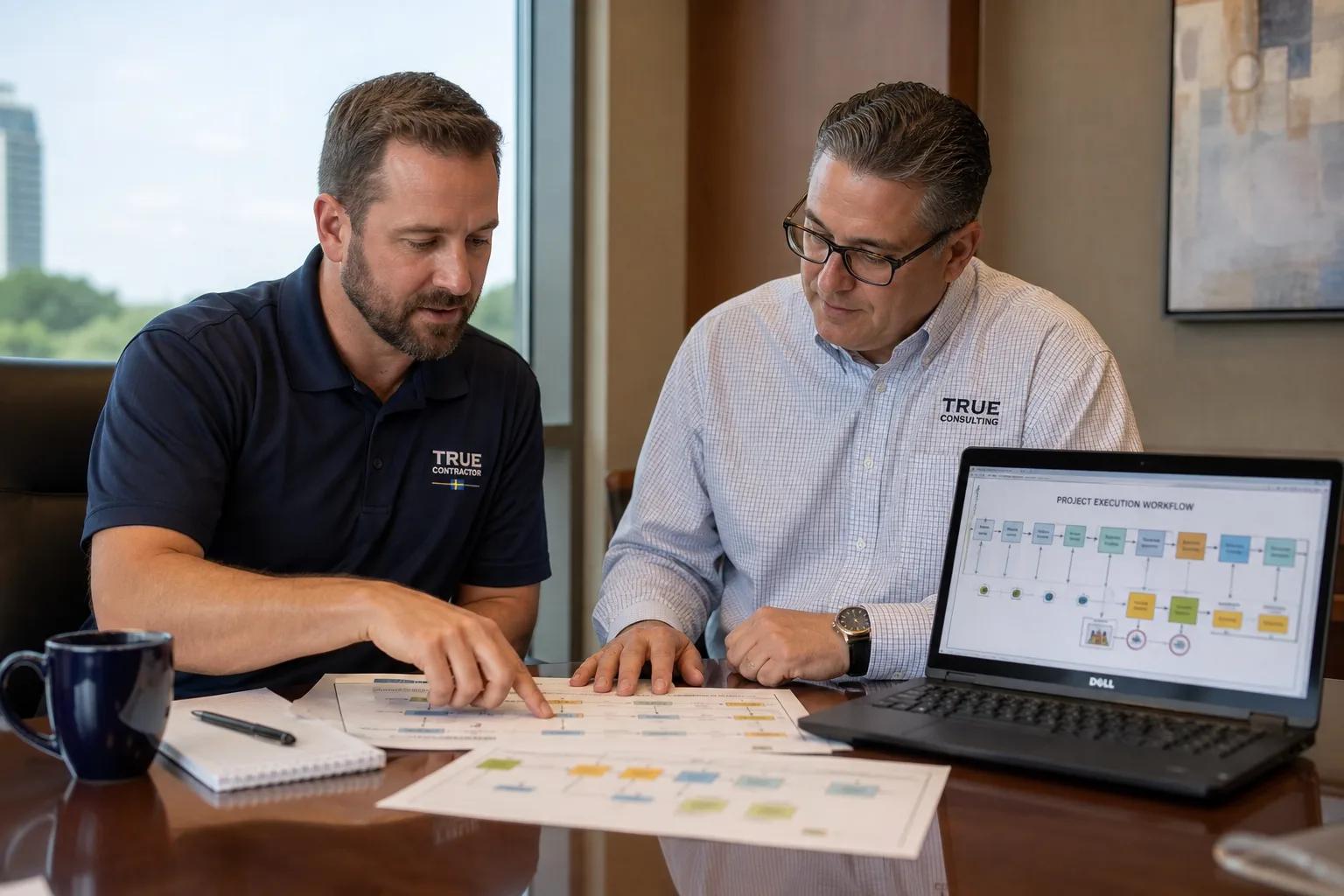
A serious business process automation company will spend the first conversation disqualifying processes, not selling automations. Expect the vendor to ask for the step count, system list, run frequency, and error rate of your target workflow before quoting anything. A vendor who agrees that every process you mention is a great automation candidate is telling you what you want to hear, not what the data supports. BPA helps organizations eliminate inefficiencies. But only when the right processes are identified first.
Your side of this gate requires three inputs: a rough map of the target process (a bullet-point list of steps works), the names of the systems involved, your CRM, field management software, invoicing platform, and a designated internal process owner. That last item is not optional. Automations without a named owner degrade in six months as APIs change and business rules shift. Assign the owner before the kickoff call, not after launch. This is where business process management discipline starts and where organizations seeking real ROI separate from those chasing novelty.
This phase also surfaces the billing model question. Fixed-price engagements force the vendor to scope the work correctly upfront; time-and-materials billing transfers all scope risk to you. For a pilot scope especially, there is no reason to accept open-ended billing. A vendor who has run these process automation services before knows what it costs. If they cannot give a fixed price for a contained workflow sprint, treat that as a red flag, not a negotiating position. The key benefits of fixed-price scoping show up immediately: clear deliverables, clear accountability, and no surprises for leadership when the invoice arrives.
Week 1-2
Discovery Sprint: The 3-5 Day Phase That Determines Whether Business Process Automation BPA Succeeds or Fails
Discovery is a 3-5 day time-boxed sprint, and BPA engagements that skip it end up automating the wrong thing beautifully. This phase costs 5-15% of the total project budget and is the most important money you will spend. During it, the consultant maps your target business processes end-to-end, interviews the staff who actually run them (not just the manager who describes them), and identifies every manual intervention, exception path, and system integration handoff the workflow touches. The goal is to discover the real process. Not the idealized version that lives in the procedure manual.
The output is a scored process inventory, not a slide deck. Each candidate workflow gets evaluated against three criteria: run frequency, time per instance, and exception rate. Processes with a failure or exception rate above 5% go back to process standardization before any automation tools touch them. Automating a broken process at scale accelerates the breakage. This step is where 70% of broad digital transformation programs begin to fail, because they skip redesign and automate the existing mess instead. Manual errors, data handling gaps, and approval workflows with undocumented exception paths all surface here, before build begins.
Tool selection also comes out of discovery, not before it. Tool selection for business process automation solutions is not a religion: Zapier fits non-technical teams with simple workflows and simple linear cross-SaaS integrations at $70-$300 per month; Make handles branching logic and complex workflows at roughly 40-60% lower per-task cost than Zapier; n8n suits teams with a developer who want self-hosting and low-code flexibility; Workato serves mid-market organizations with governance requirements and enterprise applications; custom Python or TypeScript with LangChain handles multi-step workflows needing AI reasoning, machine learning, and intelligent automation. Blue Prism and similar software robots serve enterprises needing robotic process automation at scale with full audit trails. The right intelligent automation platform follows process requirements. It does not precede them.
Discovery Length Warning
A discovery phase longer than one week for an SMB engagement signals the vendor is avoiding commitment, not being thorough. Time-box it: 3-5 days for a sprint, no more than 10 business days for a multi-department program.
End of Week 2
Process Mapping and Scoring: Deciding Which Business Processes Get Automated First
At the end of discovery, you receive a prioritized list of automation candidates ranked by expected ROI, not by complexity. The scoring matrix weights four factors: run volume, manual effort per instance, error rate from human handling, and system integration difficulty. The top-ranked workflow becomes the pilot scope. And the goal of that pilot is credibility, not scale. Start with a contained workflow that delivers measurable value in business operations and prove impact with data before expanding to more complex business processes. The benefits of business process automation compound when pilot data guides each subsequent scope decision.
Business process management discipline matters here: the vendor should show you a before/after process map, not just a list of automation tools they plan to use. You are looking for a documented reduction in manual processes, elimination of redundant data entry steps, and a clear trigger-action-outcome structure for every automated workflow. Intelligent document processing and document management steps, including data capture from invoices, contracts, and forms, need explicit exception handling documented before build begins. Contract management and accounts payable workflows are especially prone to edge cases that written scope always misses. If the map has ambiguous decision gates or undocumented exception paths, the build phase will surface those gaps as bugs. And bugs in production are more expensive than bugs on a whiteboard. Data validation rules for every input field should be defined at this stage.
The deliverable from this phase is a written scope document with three components: the exact trigger that starts the automated workflow, every action the system takes including conditional branches and business rules, and the failure-handling protocol if an automated step does not complete. Review this document carefully. Any step described as 'to be determined in build' is scope that was not actually discovered. That phrasing is how cost overruns begin on time-and-materials engagements and how automation goals drift from the original strategic objectives.
Weeks 3-8
Build and Shadow-Run: Watching Automated Workflows Go Live Against Real Business Processes
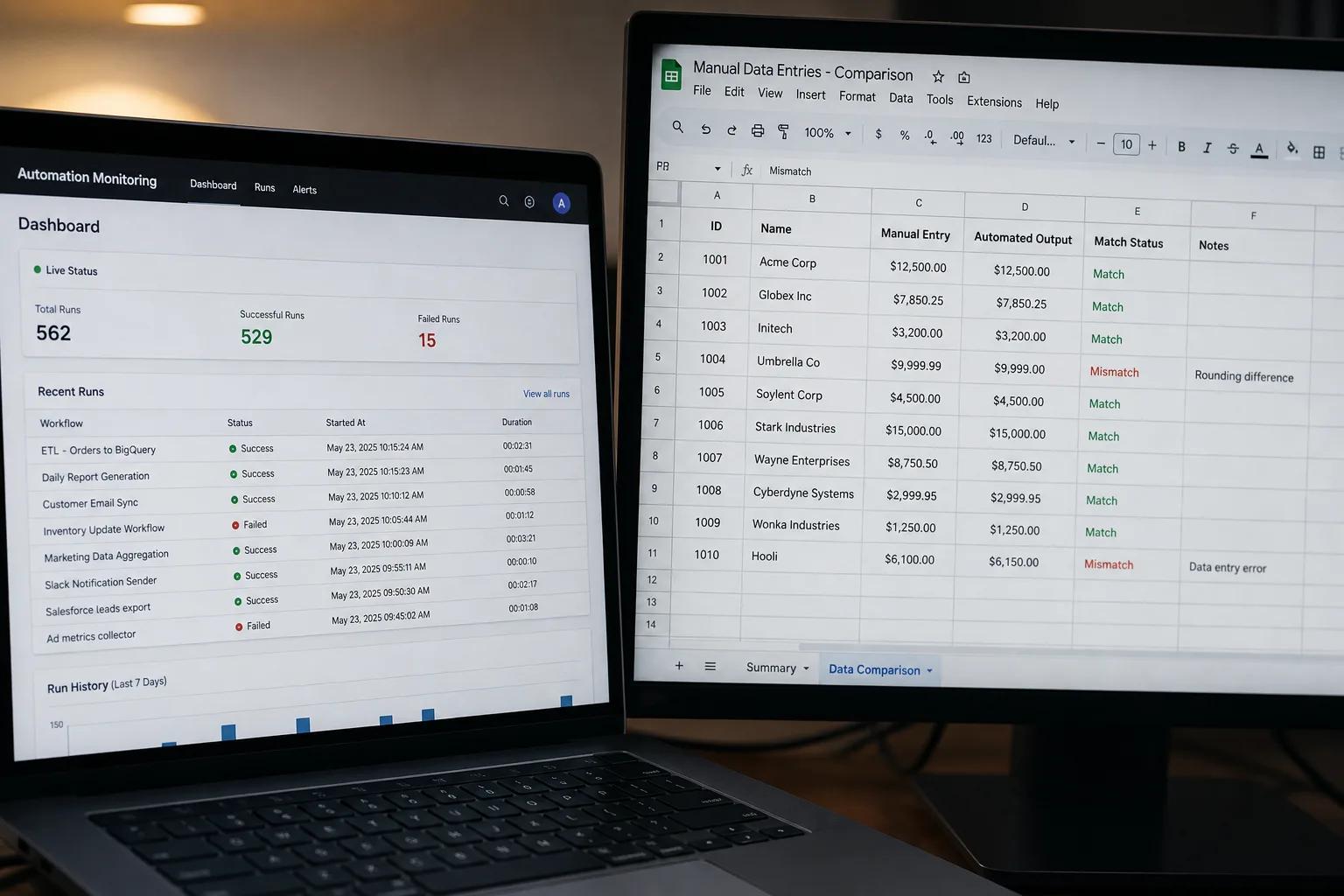
Build phase runs 3-6 weeks for a contained SMB automation engagement and 6-12 weeks for a multi-system mid-market program. During this phase, the vendor constructs the automated workflows on the agreed automation platform, connects existing systems via API or robotic process automation where native integrations do not exist, and sets up a monitoring dashboard so both sides can see workflow execution in real time. Every automated action should be logged with audit trails from day one. If the vendor is not building audit trails into the system during build, ask why. Data accuracy and data analysis depend on complete execution logs. Real time tracking of run counts, failure rates, and last-run timestamps gives both sides visibility into operational performance before go-live.
Shadow-running is the step most business process automation companies rush and most buyers do not ask about. Before any automated workflow replaces manual processes entirely, it runs in parallel for five to ten business days while staff continue doing the task by hand. The outputs of both the automated system and the manual process are compared. Discrepancies go into a fix log. The workflow does not move to production until its failure rate drops below 5%. This parallel-run step is what separates a delivered automation from a delivered liability. It catches the edge cases that written scope always misses and eliminates the manual tasks that generate the most manual errors. Improved accuracy and consistent execution are the measurable outcomes of a proper shadow-run.
During build, your process owner is not passive. They validate test cases, confirm that the automated system handles real edge cases (not just clean examples), and flag any business rule the vendor missed during discovery. Intelligent automation tools like Make or Workato can handle branching logic and conditional business rules cleanly, but only if those rules were documented correctly in the scope phase. AI agents and machine learning components, where included, require additional data validation steps to ensure the model performs accurately on your organization's specific inputs, not just on clean training data. Business users should plan on spending 2-4 hours per week during build reviewing outputs and responding to vendor questions. That time is not overhead. It is the quality gate.
What Good Monitoring Looks Like
A production-ready automated workflow has three things visible in a shared dashboard: run count, failure rate, and last-run timestamp. If the vendor hands you a live system with no monitoring, the workflow is not finished. It is abandoned.
Weeks 8-10
Handoff and Ownership: The Benefits of Business Process Automation Only Survive With a Named Owner
The deliverable from a serious BPA engagement is not a slide deck. It is live automated workflows plus documentation, monitoring dashboards, and named owner assignments that keep them alive after the consultant leaves. At handoff, you receive five artifacts: the process map (before and after), the workflow build documentation (trigger, actions, error handling), the monitoring dashboard with alert thresholds set, a runbook for the process owner covering how to pause, restart, or escalate a failed run, and credentials and platform access to every automation platform used. If any of these five are missing, the project is not complete. BPA software licenses, cloud-based platform access, and integration credentials should transfer to your team at this stage. Not remain in the vendor's environment.
Operational costs do not disappear at handoff. They shift. Ongoing retainer support from a BPA vendor runs $500-$3,500 per month and covers workflow maintenance as your existing systems update their APIs, adding conditional branches as business rules change, and scaling automated systems as volume grows. As of 2026, the average organization runs 5-7 automation tools simultaneously, and rationalizing that stack is the top operations priority. Process fragmentation is the silent killer of automation ROI, and a retainer keeps your process automation services from becoming technical debt that accumulates silently. The right retainer also covers notifications and alerts for any workflow that exceeds the 5% failure threshold.
The ROI case closes at handoff if the engagement was scoped correctly. Small businesses with 5-25 employees that automate lead follow-up, onboarding, invoicing, and reporting typically recover $30,000-$80,000 in annual value. The labor equivalent of a part-time operations coordinator. Automating routine tasks and repetitive business tasks in these categories frees up valuable employee time for more strategic activities that humans handle better than software. Across all organization sizes, 60% achieve ROI within 12 months, with average productivity increases of 25-30% in automated processes and error reduction rates of 40-75% compared to manual processing. Those numbers hold when process selection was disciplined and the pilot scope stayed contained. They fall apart when buyers skip the pilot and go straight to a multi-department program.
Month 3 and Beyond
BPA Solutions That Expand: Scaling Automation Tools After a Successful Pilot
Expansion from a successful pilot follows one gate: the pilot workflow must run at below 5% failure rate for 30 consecutive days before the next process enters the build queue. This is not a conservative standard. It is the minimum bar for a system that business users will trust enough to stop running manual backups. Teams that skip this gate and expand too fast accumulate disconnected automations that create complexity instead of clarity. That is exactly the trap the average organization has already fallen into with its 5-7 siloed automation platforms, each optimizing a different business function without connecting to the others. Process fragmentation at this stage increases operational delays and forces human agents to manually reconcile data across systems. Exactly the repetitive manual work that automation was supposed to eliminate.
For mid-market programs, expansion introduces business process management and governance: a written policy for which automation platforms are approved, who can commission new workflows, and how business process data is retained for regulatory compliance, auditing, and security purposes. Workflow orchestration across multiple systems, connecting CRM data to invoicing, finance, employee onboarding, and report generation in a single coordinated sequence, requires governance before any new workflow is commissioned. Workato and Microsoft Power Automate both support this governance layer natively and integrate seamlessly with enterprise applications. n8n supports it with more configuration work but lower per-execution cost at scale. Advanced technologies like artificial intelligence and machine learning can extend process automation into less structured workflows, including intelligent document processing, data capture from unstructured sources, and customer onboarding logic, but only after the foundational rule-based automations are proven and stable. The governance conversation should start during the pilot phase, not after the stack has grown to six tools.
Gartner predicts over 40% of agentic AI projects will be canceled by end of 2027 due to escalating costs, unclear business value, and inadequate risk controls. All scoping and vendor-selection failures rather than engineering failures. The pattern that avoids this outcome is identical at every organization size: one workflow, proven ROI, then expand. A well-scoped automation consulting engagement should return 5-10 times the consulting fee within 12 months. If the math does not work at pilot scale, it will not work at program scale either. Trying to streamline operations across multiple departments before a single workflow has proven durable is the clearest path to becoming one of Gartner's canceled projects. BPA helps most when expansion is disciplined and data-driven. Not when it chases a vendor's roadmap.
Before You Sign
Six Questions to Pressure-Test Any Business Process Automation Company in 20 Minutes
Six questions separate business process automation companies with real engagement experience from those selling generic digital transformation. First: Can you give me a fixed price for the discovery sprint and the pilot build before we sign? A capable vendor can. Second: What is your workflow failure-rate threshold before you call a build done, and how do you measure it? The answer should be below 5%, tracked in a shared dashboard with real time tracking. Third: Show me a process you declined to automate for a client and explain why. A vendor who has never said no is not doing discovery. They are doing sales. Ask to review examples from industries similar to yours, including healthcare, logistics, retail, finance, banking, or insurance if relevant.
Fourth: What does your post-deployment support model look like for the first 90 days after go-live? No post-deployment support in the proposal predicts abandonment. Fifth: Can you connect me with a reference whose automations have been running for at least 12 months. Not just a launch-day reference? Given that EY puts RPA failure rates at 30-50% and Deloitte found 63% of firms missed RPA delivery deadlines, a reference covering only the launch tells you nothing about system durability or whether the client can still access and manage the software applications the vendor deployed. Sixth: Which automation platform do you plan to use, and why this one over the alternatives for our specific workflow? If the answer is the same tool regardless of your process profile, the recommendation was made before discovery happened. A vendor who can explain when they choose low-code platforms like Make versus when they write custom code versus when they deploy software robots like Blue Prism is demonstrating real capability, not reciting a pitch.
These six questions take under 20 minutes and surface the two root causes behind the 70% digital transformation failure rate documented as of 2026: poor process selection and absence of a structured engagement model. Both are vendor-side failures, and both are visible before you sign anything. The questions also reveal whether you are talking to a vendor who can actually optimize business processes and streamline workflows across your organization, or one who automates repetitive business tasks using a single template approach regardless of fit. The difference shows up in the specificity of the answers, not the confidence of the pitch. Organizations seeking to reduce manual effort, lower operational costs, and increase productivity deserve a vendor who can demonstrate how their approach delivers consistent execution across every engagement. Not just a compelling slide deck.

The Deliverable Is Not Software: It Is a Running System With a Named Owner
Most buyers expect the engagement to end when the automated workflows go live. That is when the real risk begins. Automations without an assigned internal owner degrade in six months as APIs change, business rules shift, and edge cases accumulate. The five non-negotiable handoff artifacts, process map, workflow documentation, monitoring dashboard, owner runbook, and platform credentials, are what convert a launch into a durable business process automation solution that actually improves business performance over time.
A contained, fixed-price Workflow Sprint is the lowest-risk way to prove what a business process automation service can actually deliver for your operations. Before committing to a program-scale engagement. One workflow, one owner, one set of measurable outcomes. The data from that pilot tells you exactly what to automate next and whether the vendor earned a second engagement. BPA helps businesses reduce operational costs, eliminate manual labor on repetitive tasks, improve overall efficiency, and free employees to focus on strategic work that creates real growth. If you are ready to identify your first high-ROI candidate process, the right next step is a 30-minute scoping call where we run the volume and complexity check together. No fixed quote until we have looked at your data.