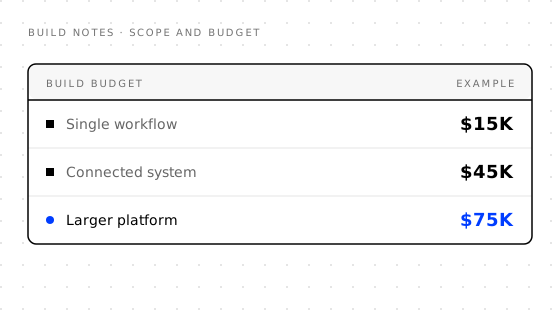
Custom software for a small business costs $15,000 for a single-workflow tool delivered in six weeks, $45,000–$75,000 for a connected system tying three or four existing tools together, and $75,000–$150,000+ once compliance layers, mobile access, or AI features enter scope. The Clutch 2025–2026 verified average of $132,480 reflects large enterprise builds, not fixed-price sprint work that owner-run businesses at $5M–$50M actually need. Post-launch maintenance adds 15–25% of build cost per year. A 10-person team paying $65 per seat per month across three SaaS tools that don't talk to each other spends $23,400 per year. A $15,000 fixed-price build with full code ownership pays for itself in year one.
-
$15,000 fixed priceSingle-workflow tool, six-week sprint, you own the code
-
$45,000–$75,000 fixed priceConnected system tying 3–4 existing tools into one dashboard
-
15–25% of build cost per yearAnnual post-launch maintenance on any custom software build
-
20–40% cost addedHIPAA, PCI-DSS, or GDPR compliance on top of any base estimate
-
65.6% of projectsHit scope creep adding 10–25% to cost without a fixed-price contract
-
$8,700/employee/yearAverage SaaS spend in 2024, trending to $10,800 by end of 2026
-
$132,480 averageClutch verified cost. Reflects enterprise builds, not SMB sprints
-
Year one paybackA $15K build beats $23,400/yr in SaaS fees for a 10-person team
Custom software for a small business costs $15,000 for a single-workflow tool and $45,000–$75,000 for a connected system tying three or four existing tools together. Both fixed-price, both with client source-code ownership. Those numbers come from real, scoped, sprint-based projects, not the $132,480 Clutch average reflecting enterprise builds. What determines your number is scope: one workflow versus many, one integration versus six, and whether compliance requirements like HIPAA or PCI-DSS are in scope from the start. A GoodFirms 2026 survey confirms 66% of SMB software projects land between $30,000 and $100,000.

Custom Software Cost in 2026: The Real Price Tiers
| Tier | Price range | What's included | Best for |
|---|---|---|---|
| Single-Workflow Tool (Fixed-Price Sprint) | $15,000 fixed | One automated workflow, one third-party integration, clean UI, client owns source code. Delivered in six weeks | Owner-run businesses replacing one broken manual process or one SaaS tool that barely fits |
| Connected System (Multi-Tool Integration) | $45,000–$75,000 fixed | Custom operations dashboard tying 3–4 existing tools together, role-based access control, real data layer, client owns code | Businesses juggling three or more tools that don't talk to each other and manually moving data between them daily |
| Growth-Stage Custom Platform | $75,000–$150,000+ | Multi-module application, compliance layer (HIPAA, PCI-DSS, GDPR), mobile access, AI or real-time data processing, full QA and security audit | Businesses in regulated industries or those replacing a legacy system with a purpose-built platform |
| Enterprise / Agency-Staffed Build | $150,000–$500,000+ | Large development team, multi-phase roadmap, full project management, discovery sprints, ongoing retainer, potential offshore staffing mix | Companies with complex legacy migrations, multi-tenant architecture needs, or 12-plus-month product roadmaps requiring dedicated teams |
What You Get at Each Price Point
Single-Workflow Tool (Fixed-Price Sprint)
A $15,000 fixed-price sprint covers one workflow automated end to end, one third-party integration, say, pushing web form data into QuickBooks, and a clean UI your team actually uses. No per-seat fees, no recurring license; the client owns the source code on day one. AI coding tools like Cursor or GitHub Copilot can cut templated-feature coding time by 20–40%, making a US-based team viable at this price with a locked scope.
Post-launch maintenance runs 15–25% of build cost annually: $2,250–$3,750 per year on a $15,000 build. A fraction of typical SaaS seat fees for a tool that doesn't fit your process. Keep AI features and compliance requirements out of scope at launch; add them in a Phase 2 sprint once the core workflow is stable.
Connected System (Multi-Tool Integration)
A $45,000–$75,000 connected system ties three or four existing tools, QuickBooks, a CRM, a scheduling app, into one operations dashboard, adds role-based access control so field staff see different screens than managers, and establishes a real data layer so nothing gets copy-pasted between apps.
GoodFirms' 2026 survey confirms 66% of SMB software projects land in the $30,000–$100,000 range, validating this tier as where disciplined, scoped builds cluster. Code ownership matters most here: a connected system becomes infrastructure, and you don't want a vendor holding the keys when it runs your daily operations.
Growth-Stage Custom Platform
HIPAA, PCI-DSS, and GDPR compliance each add 20–40% to a base estimate. A $75,000 connected system with a HIPAA layer moves to $90,000–$105,000 before adding mobile or AI features. AI integration and real-time data processing add another 10–20%, and compressing a standard timeline by half carries a 25–40% cost premium independently.
The Clutch 2025–2026 verified average is $132,480 over roughly 13 months, inflated by enterprise builds. Buyers at this tier should expect year-one total cost of ownership, build plus first-year maintenance plus hosting and third-party API fees, between $90,000 and $200,000 depending on compliance scope and feature count.
Enterprise / Agency-Staffed Build
US-based senior developers bill at $125–$250+ per hour in 2026. A six-person team running a 12-month engagement at the low end produces a build cost well above $500,000 before project management, QA (15–25% of budget), or UX/UI design (10–20%). Offshore teams in Latin America ($45–$75/hr) and Asia ($30–$50/hr) cut raw labor cost but add coordination overhead. Fixed-price contracts at this scale include a 15–30% risk premium for scope uncertainty.
GoodFirms found scope creep adds 10–25% to cost in 65.6% of engagements, and over half of all projects exceed original budget by at least 89%. Owner-run businesses at $5M–$50M revenue rarely need this tier; the $15,000–$75,000 fixed-price tiers solve the same operational problems at a fraction of the cost and timeline.

Pros and Cons of Custom Software vs. SaaS for Small Businesses
- You own the asset outright. Under US copyright law, the developer owns your code by default unless the contract contains an explicit written assignment of rights. A fixed-price build with a proper IP assignment clause, 'Developer hereby assigns to Client all right, title, and interest', converts the software into a balance-sheet asset you can sell, license, or hand to a new vendor on day one.
- No per-seat fees, ever. Average SaaS spend per employee hit $8,700 in 2024 and is trending toward $10,800 in 2026. A 10-person team pays roughly $87,000 per year in SaaS fees, often with 30–40% of paid seats sitting idle. One custom tool with no per-seat pricing eliminates that category of waste entirely.
- Fixed price means no billing surprises. Hourly billing from a US-based senior developer runs $125–$250+ per hour. A six-week sprint at even the low end costs $30,000 in raw labor before QA or design. A fixed-price contract locks total cost before work starts, transferring scope risk from buyer to vendor.
- Built for your exact workflow, not a generic average. PMI agile research found 64–80% of features shipped in software products are rarely or never used after launch. Custom software scoped to one specific workflow ships zero unused features by design, which is also why a disciplined six-week sprint can deliver a working tool when an off-the-shelf product takes months of configuration.
- Maintenance costs are predictable and bounded. Post-launch maintenance runs 15–25% of original build cost per year. On a $15,000 build, that is $2,250–$3,750 annually. A number you can plan around, unlike SaaS renewals that compound year over year with no equity accumulation.
- A $15,000 build can pay back in year one for a 10-person team. A team paying $65 per seat per month across three SaaS tools spends $23,400 per year and still moves data manually between them. One custom tool at $15,000 replaces that spend in year one and runs for under $4,000 per year in maintenance from year two onward.
- Two-thirds of projects exceed budget. GoodFirms found 65.6% of custom software projects see scope creep add 10–25% to cost, and over 52% exceed original budget by at least 89%. The only structural fix is a fixed-price contract with a locked scope signed before a line of code is written.
- The build cost is only 20–50% of total lifetime cost. Hosting, third-party API fees, security audits, and ongoing feature updates push year-one total cost of ownership above the initial quote. A $45,000 connected system can reach $60,000–$70,000 in year one once cloud hosting, QA, and first-year maintenance are included.
- Compliance requirements can add 20–40% overnight. A $15,000 single-workflow quote moves to $18,000–$21,000 the moment HIPAA or PCI-DSS enters scope. Buyers in healthcare payments or financial services must disclose compliance requirements before getting a quote, not after signing.
- Rush delivery adds 25–40% to the price. Compressing a standard timeline by half raises cost rather than reducing it, adding a 25–40% premium. A six-week sprint works because scope is locked before development starts. Buyers who want speed and keep expanding scope pay both the rush premium and the scope-creep tax simultaneously.
- Bad IP contract language leaves you with a license, not ownership. A paid invoice buys the right to use the software, not legal ownership of the code. Many agency contracts say 'license' when buyers assume 'own'. An ambiguity that surfaces painfully during an acquisition, a fundraising round, or when switching vendors.
How to Size Your Custom Software Budget Before You Talk to a Vendor
- Map the one workflow that costs you the most money today Identify the single process your team manually patches between two or more tools. That is your $15,000 scope. Scope clarity is the single biggest cost driver, separating six-week sprints from 13-month, $132,480 engagements.
- Count your current SaaS spend before you price the build Pull your last 12 months of SaaS invoices and flag tools with 30–40% seat utilization. That dead spend, typically $8,700+ per employee per year, is the budget a custom build repurposes. If annual SaaS cost on the target workflow exceeds $15,000, a fixed-price build breaks even in year one.
- Demand a fixed-price quote with an explicit IP assignment clause Reject any proposal that bills hourly without a cap, and reject any contract that says 'license' rather than 'Developer hereby assigns to Client all right, title, and interest'. The first exposes you to unlimited billing; the second leaves the vendor owning your code after you've paid the invoice.
- Disclose compliance requirements before the first call HIPAA, PCI-DSS, and GDPR each add 20–40% to a base estimate, so a $15,000 quote becomes $18,000–$21,000 the moment a compliance layer enters scope. Tell the vendor upfront so the quote reflects reality, not a number that grows after you sign.
- Budget 15–25% of build cost annually for maintenance from day one A $15,000 build costs $2,250–$3,750 per year to maintain; a $75,000 build costs $11,250–$18,750 per year. Bake those numbers into your total cost model before comparing against SaaS renewal costs on a five-year horizon.
- Defer AI features and mobile access to Phase 2 AI integration adds 10–20% to mid-range builds and mobile development adds another full design-and-QA cycle. Launching Phase 1 without them cuts initial budget by $7,500–$20,000 and gets working software in front of your team in six weeks instead of six months.

The Hourly Billing Trap: Why 'We'll Scope It As We Go' Always Costs More
A vendor who quotes hourly with no cap transfers 100% of scope risk to you. GoodFirms found scope creep adds 10–25% to cost in 65.6% of engagements, and over half of all projects exceed original budget by at least 89%. A $40,000 hourly estimate drifting 89% over budget lands at $75,600. The same price as a fixed-price connected system with full IP assignment and a locked delivery date. Demand a fixed price and signed scope document before work begins.
Custom software costs $15,000 for a single-workflow tool and $45,000–$75,000 for a connected system. Both fixed-price, both with client code ownership. The Clutch average of $132,480 reflects large enterprise builds, not scoped sprint work that owner-run businesses at $5M–$50M actually need. If your team pays more than $15,000 per year in SaaS fees for tools that don't communicate and still moves data manually, a fixed-price build can pay for itself in year one and runs for under $4,000 annually in maintenance from year two. Confirm the contract says 'assigns,' not 'licenses'. That one word separates owning a business asset from renting someone else's code.